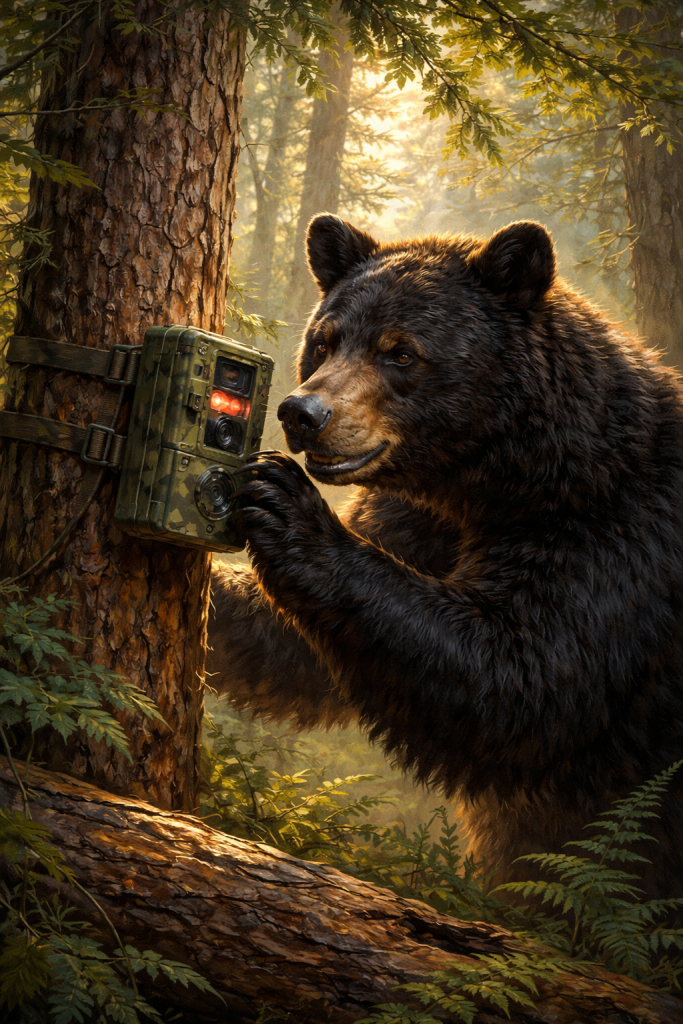
Trail cameras are meant to be quiet observers—small windows into the private lives of wildlife. But every so often, the camera becomes part of the story. Scratched lenses. Tooth marks. A unit twisted sideways… or gone altogether.
When a bear appears to be “attacking” or even eating a trail camera, it’s tempting to see it as aggression or destruction. In reality, these moments reveal just how intelligent, curious, and instinct-driven bears truly are—especially during winter, and especially when cubs are involved.
Here are eight well-documented reasons bears interact so intensely with trail cameras, and what those moments teach us about life in the wild.
1️⃣ Curiosity and Intelligence
Black bears are brilliant animals. When they encounter something unfamiliar strapped to a tree—something that doesn’t smell, feel, or behave like bark—they investigate.
Bears explore the world using their nose, paws, and mouth. What looks like an “attack” is often the final step of curiosity: What is this thing?
2️⃣ Human Scent Attraction
Even the cleanest trail camera often carries traces of human scent. Bears can detect:
- Soap or hand sanitizer
- Lotion or sunscreen
- Food smells from gloves or pockets
- Plastic or rubber odors
To a bear’s nose, these scents are loud. Once a scent is detected, investigation almost always follows—and biting is a natural way to test an object.
3️⃣ Plastic Resembles Food Containers
Bears learn through experience that plastic boxes often mean calories. Coolers, trash bins, feed buckets—many food sources share the same hard, boxy design as trail cameras.
A camera doesn’t look like a camera to a bear. It looks like a possibility.
4️⃣ Sound Sensitivity
Trail cameras marketed as “silent” can still:
- Click faintly
- Whir during activation
- Emit barely audible electronic sounds
Bears have excellent hearing. A repeated or unfamiliar sound may prompt a bear to locate and silence the source—especially if it’s along a well-used trail.
5️⃣ Infrared or Red Light Glow
Some bears appear able to notice the faint glow of infrared or red LEDs used for nighttime photos. To them, this can resemble:
- An eye
- A reflective surface
- Something watching
This often results in direct, face-to-camera contact—and sometimes teeth.
6️⃣ Boundary and Comfort-Zone Behavior
While bears aren’t territorial in the traditional sense, they do establish areas of comfort and routine. Cameras placed near:
- Feeding areas
- Travel corridors
- Bedding or den sites
Trail cameras are seen as objects that don’t belong.
7️⃣ Play Behavior
Younger bears—and occasionally mothers with older cubs—engage in playful destruction. Tugging, pawing, and chewing objects helps build strength and coordination.
To a bear, a trail camera can be:
- A toy
- A puzzle
- A challenge
Play doesn’t mean harmless—for the camera—but it’s a natural behavior.
8️⃣ Protective Instinct (Especially Mothers with Cubs)
For a mother bear, particularly in winter, protection is non-negotiable. Cubs are born tiny and vulnerable, food is scarce, and energy must be conserved.
Any unfamiliar object near her cubs is treated seriously. Investigation may escalate quickly—not out of aggression, but out of maternal instinct. Removing the object removes the uncertainty.
When a bear bites or carries off a trail camera, it isn’t anger or malice—it’s intelligence meeting instinct. These moments remind us that wildlife cameras don’t just observe the forest; they temporarily become part of it.
Winter survival is written in careful decisions, heightened senses, and fierce devotion—especially for mothers. Wildlife invites us to watch with curiosity, respect with humility, and remember that every tooth mark tells a story far older than our technology.